EnglishFrançaisEspañolPortugueseDeutsch
Italiano
Imprint and Privacy
Facebook
LinkedIn
YouTube
Instagram
    • LORENTZ S
    • Dimensionamento
    • Download
    • Dove acquistare?
    • Aiuto

Aiuto

array(6) { ["headers"]=> object(Requests_Utility_CaseInsensitiveDictionary)#8862 (1) { ["data":protected]=> array(12) { ["date"]=> string(29) "Wed, 13 May 2026 17:45:23 GMT" ["server"]=> string(6) "Apache" ["access-control-allow-origin"]=> string(1) "*" ["expires"]=> string(29) "Thu, 19 Nov 1981 08:52:00 GMT" ["cache-control"]=> string(35) "no-store, no-cache, must-revalidate" ["pragma"]=> string(8) "no-cache" ["strict-transport-security"]=> string(16) "max-age=63072000" ["set-cookie"]=> string(62) "PHPSESSID=i6mmdc6nqo4q1c9f18s7fq06hs; path=/; HttpOnly; Secure" ["x-ah-t"]=> string(28) "t=1778694323112965 D=4380001" ["upgrade"]=> string(2) "h2" ["x-xss-protection"]=> string(13) "1; mode=block" ["content-type"]=> string(16) "application/json" } } ["body"]=> string(2003100) "{"categories":{"580100":{"cat_no":"580100","cat_text_en":"Understanding solar pumps","cat_text_fr":"Comprendre les pompes solaires","cat_text_es":"Entendiendo las bombas solares","cat_text_pt":"Entendendo as bombas solares","cat_text_de":"Solarpumpen verstehen","cat_text_it":"Capire le pompe solari"},"580200":{"cat_no":"580200","cat_text_en":"Choosing your pump and accessories","cat_text_fr":"Choisir sa pompe et ses accessoires","cat_text_es":"Elecci\u00f3n de su bomba y accesorios","cat_text_pt":"Escolhendo sua bomba e acess\u00f3rios","cat_text_de":"Pumpe und Zubeh\u00f6r ausw\u00e4hlen","cat_text_it":"Scelta della pompa e degli accessori"},"580300":{"cat_no":"580300","cat_text_en":"Installing your pump system","cat_text_fr":"Installation de votre syst\u00e8me de pompe","cat_text_es":"Instalaci\u00f3n de su sistema de bomba","cat_text_pt":"Instalando seu sistema de bombas","cat_text_de":"Installation","cat_text_it":"Installazione del sistema di pompaggio"},"580400":{"cat_no":"580400","cat_text_en":"Using your pump system","cat_text_fr":"Utilisation de votre syst\u00e8me de pompe","cat_text_es":"Uso de su sistema de bombeo","cat_text_pt":"Usando seu sistema de bombeamento","cat_text_de":"Benutzung","cat_text_it":"Usando il tuo sistema di pompaggio"},"580500":{"cat_no":"580500","cat_text_en":"Troubleshooting and support","cat_text_fr":"D\u00e9pannage et assistance","cat_text_es":"Soluci\u00f3n de problemas y soporte","cat_text_pt":"Solu\u00e7\u00e3o de problemas e suporte","cat_text_de":"Fehlerbehebung und Support","cat_text_it":"Risoluzione dei problemi e supporto"}},"qty":54,"items":{"2275":{"en":{"categories":{"1":"580500"},"title":"Why does my S1 controller have no LEDs illuminated (controller appears to be off)?","subTitle":"","header":"","html":"

If no LEDs are illuminated on the S1 controller, this usually indicates that the system is not receiving power or that it has not been fully commissioned yet.
In most cases, this condition is related to the PV power supply rather than a controller fault.<\/p>

Before assuming a defective controller, please verify that the system has been installed and connected correctly.<\/p>

Check the PV power supply<\/H2><\/tocentry>

As a first step, carefully review the complete PV installation procedure and pay special attention to the following points:<\/p>

  • Use a suitable PV module configuration if the input voltage is too low.<\/li>
  • Check for loose, dirty, or wet PV connections (including any extension cables).
    • Ensure all plugs are clean, dry, and properly connected<\/li> <\/ul> <\/li>
    • Make sure all PV modules are correctly wired to the controller<\/li>
    • If a PV disconnect switch is installed:
      • Check the connections
        If necessary, contact your distributor to replace the switch<\/li> <\/ul> <\/li>
      • If the input voltage is too high (for S1-200 Voc > 55 V DC and for S1-700 Voc > 220 V DC):
        • Disconnect the system immediately<\/li>
        • Contact your distributor to replace the controller<\/li> <\/ul> <\/li> <\/ul>

          Please refer to the following literature for more information:<\/p>

          • <\/i>S1-200 systems: connecting PV modules in series and parallel<\/a><\/li>
          • <\/i>Required solar power input (low power)<\/a><\/li>
          • <\/i>Checking the voltage of the S1 pumping system<\/a><\/li><\/ul><\/div> <\/div>

            Verify the complete system installation<\/H2><\/tocentry>

            Also ensure that the full step-by-step installation of the S1 pump system has been completed correctly, an incomplete or incorrect installation can prevent the controller from powering up. Please refer to the following literature for more information:<\/p>

            • <\/i>Installing your S1-200 pump system step by step<\/a><\/li>
            • <\/i>Installing your S1-700 pump system step by step<\/a><\/li><\/ul><\/div> <\/div>

              Check available system data (if applicable)<\/H2><\/tocentry>

              If the system has been operated previously and the S-Connect app was used, recorded events may provide valuable information about what happened.<\/p>

              Please export all available data by following this guide:

              • <\/i>Exporting pump data in the S-Connect app<\/a><\/li><\/ul><\/div>

                Once exported, send the complete ZIP file to LORENTZ support. This will help our technical team analyze the situation and provide more accurate assistance.<\/p> <\/div>

                Further reading<\/H2><\/tocentry>
                • <\/i>Troubleshooting overview<\/a><\/li>
                • <\/i>Meaning of LED sequences<\/a><\/li><\/ul><\/div>","sortIndex":0}},"2269":{"en":{"categories":{"1":"580100"},"title":"Understanding LORENTZ S1 pump type keys","subTitle":"","header":"","html":"

                  LORENTZ uses a structured pump type key to clearly identify the main characteristics of the pump end used in S1 pumping systems.
                  By reading the pump designation, it is possible to determine key information such as the pump technology, size, temperature class, number of stages, and outlet connection type.<\/p>

                  The S1 product range includes two different pump technologies, each with its own type key structure:<\/p>

                  • Helical rotor pumps (HRE) used in S1-200 systems<\/li>
                  • Centrifugal pumps (CST) used in S1-700 systems<\/li> <\/ul>

                    Understanding the type key helps installers, system designers and service personnel to correctly identify the pump configuration and ensure proper application.<\/p>

                    Helical rotor pump end naming (S1-200)<\/H2><\/tocentry>

                    Helical rotor pumps are positive displacement pumps designed for higher heads and lower flow rates. They are used in LORENTZ S1-200 systems.<\/p>

                    Example and type key explanation<\/H3><\/tocentry>

                    PE S1-HR<\/strong>-YY<\/strong>-Z<\/strong>-PASN-FNSX-HA<\/strong><\/p>

                    fullscreen<\/i><\/div><\/div><\/div>

                    Centrifugal pump end naming (S1-700)<\/H2><\/tocentry>

                    Centrifugal pumps are primarily used in S1-700 systems and are suitable for applications requiring larger water volumes.<\/p>

                    Example and type key explanation<\/H3><\/tocentry>

                    PE S1-CST<\/strong>-Y<\/strong>-Z<\/strong>-0-SPN-BBX-NC<\/strong><\/p>

                    fullscreen<\/i><\/div><\/div><\/div>

                    Further reading<\/H2><\/tocentry>
                    • <\/i>Flow and head of a LORENTZ S1 pump system<\/a><\/li>
                    • <\/i>Suitable water temperature for S1 pump systems<\/a><\/li>
                    • <\/i>Application types for S1 systems<\/a><\/li><\/ul><\/div>","sortIndex":0},"fr":{"categories":{"1":"580100"},"title":"Comprendre la d\u00e9signation des pompes S1 LORENTZ","subTitle":"","header":"","html":"

                      LORENTZ utilise une désignation de pompe structurée afin d’identifier clairement les principales caractéristiques de la tête de pompe utilisée dans les systèmes de pompage S1.
                      En lisant la désignation de la pompe, il est possible de déterminer des informations clés telles que la technologie de la pompe, la taille, la classe de température, le nombre d’étages et le type de raccordement de refoulement.<\/p>

                      La gamme de produits S1 comprend deux technologies de pompage différentes, chacune disposant de sa propre structure de désignation :<\/p>

                      • Pompes à rotor hélicoïdal (HRE) utilisées dans les systèmes S1-200<\/li>
                      • Pompes centrifuges (CST) utilisées dans les systèmes S1-700<\/li> <\/ul>

                        Comprendre la désignation aide les installateurs, les concepteurs de systèmes et le personnel de maintenance à identifier correctement la configuration de la pompe et à garantir une application appropriée.<\/p>

                        Désignation de la tête de pompe à rotor hélicoïdal (S1-200)<\/H2><\/tocentry>

                        Les pompes à rotor hélicoïdal sont des pompes à déplacement positif conçues pour des hauteurs élevées et des débits plus faibles. Elles sont utilisées dans les systèmes LORENTZ S1-200.<\/p>

                        Exemple et explication de la désignation<\/H3><\/tocentry>

                        PE S1-HR<\/strong>-YY<\/strong>-Z<\/strong>-PASN-FNSX-HA<\/strong><\/p>

                        fullscreen<\/i><\/div><\/div><\/div>

                        Désignation de la tête de pompe centrifuge (S1-700)<\/H2><\/tocentry>

                        Les pompes centrifuges sont principalement utilisées dans les systèmes S1-700 et conviennent aux applications nécessitant des volumes d’eau plus importants.<\/p>

                        Exemple et explication de la désignation<\/H3><\/tocentry>

                        PE S1-CST<\/strong>-Y<\/strong>-Z<\/strong>-0-SPN-BBX-NC<\/strong><\/p>

                        fullscreen<\/i><\/div><\/div><\/div>

                        Pour en savoir plus<\/H2><\/tocentry>
                        • <\/i>D\u00e9bit et hauteur d\u2019un syst\u00e8me de pompage LORENTZ S1<\/a><\/li>
                        • <\/i>Temp\u00e9rature de l\u2019eau appropri\u00e9e pour les syst\u00e8mes de pompage S1<\/a><\/li>
                        • <\/i>Types d\u2019applications des syst\u00e8mes S1<\/a><\/li><\/ul><\/div>","sortIndex":0},"es":{"categories":{"1":"580100"},"title":"Comprender la nomenclatura de las bombas S1 de LORENTZ","subTitle":"","header":"","html":"

                          LORENTZ utiliza una nomenclatura estructurada de bombas para identificar claramente las principales características del cabezal de la bomba utilizado en los sistemas de bombeo S1.
                          Al leer la designación de la bomba, es posible determinar información clave como la tecnología de la bomba, el tamaño, la clase de temperatura, el número de etapas y el tipo de conexión de descarga.<\/p>

                          La gama de productos S1 incluye dos tecnologías de bombeo diferentes, cada una con su propia estructura de nomenclatura:<\/p>

                          • Bombas de rotor helicoidal (HRE) utilizadas en sistemas S1-200<\/li>
                          • Bombas centrífugas (CST) utilizadas en sistemas S1-700<\/li> <\/ul>

                            Comprender la nomenclatura ayuda a instaladores, diseñadores de sistemas y personal de servicio a identificar correctamente la configuración de la bomba y garantizar una aplicación adecuada.<\/p>

                            Nomenclatura del cabezal de la bomba de rotor helicoidal (S1-200)<\/H2><\/tocentry>

                            Las bombas de rotor helicoidal son bombas de desplazamiento positivo diseñadas para mayores alturas y menores caudales. Se utilizan en los sistemas LORENTZ S1-200.<\/p>

                            Ejemplo y explicación de la nomenclatura<\/H3><\/tocentry>

                            PE S1-HR<\/strong>-YY<\/strong>-Z<\/strong>-PASN-FNSX-HA<\/strong><\/p>

                            fullscreen<\/i><\/div><\/div><\/div>

                            Nomenclatura del cabezal de la bomba centrífuga (S1-700)<\/H2><\/tocentry>

                            Las bombas centrífugas se utilizan principalmente en los sistemas S1-700 y son adecuadas para aplicaciones que requieren mayores volúmenes de agua.<\/p>

                            Ejemplo y explicación de la nomenclatura<\/H3><\/tocentry>

                            PE S1-CST<\/strong>-Y<\/strong>-Z<\/strong>-0-SPN-BBX-NC<\/strong><\/p>

                            fullscreen<\/i><\/div><\/div><\/div>

                            Más información<\/H2><\/tocentry>
                            • <\/i>Caudal y altura de elevaci\u00f3n de un sistema de bombeo S1 de LORENTZ<\/a><\/li>
                            • <\/i>Temperatura del agua adecuada para los sistemas de bombeo S1<\/a><\/li>
                            • <\/i>Tipos de aplicaci\u00f3n para los sistemas S1<\/a><\/li><\/ul><\/div>","sortIndex":0},"it":{"categories":{"1":"580100"},"title":"Comprendere i codici modello delle pompe S1 LORENTZ","subTitle":null,"header":"","html":"

                              LORENTZ utilizza codici modello strutturati per identificare chiaramente le principali caratteristiche della testa della pompa utilizzata nei sistemi di pompaggio S1.
                              Leggendo la designazione della pompa, è possibile determinare informazioni chiave come la tecnologia della pompa, la dimensione, la classe di temperatura, il numero di stadi e il tipo di collegamento di mandata.<\/p>

                              La gamma di prodotti S1 comprende due diverse tecnologie di pompaggio, ciascuna con la propria struttura di codici modello:<\/p>

                              • Pompe a rotore elicoidale (HRE) utilizzate nei sistemi S1-200<\/li>
                              • Pompe centrifughe (CST) utilizzate nei sistemi S1-700<\/li> <\/ul>

                                Comprendere i codici modello aiuta installatori, progettisti di sistema e personale di assistenza a identificare correttamente la configurazione della pompa e a garantire un’applicazione corretta.<\/p>

                                Codice modello della testa della pompa a rotore elicoidale (S1-200)<\/H2><\/tocentry>

                                Le pompe a rotore elicoidale sono pompe a spostamento positivo progettate per prevalenze elevate e portate ridotte. Sono utilizzate nei sistemi LORENTZ S1-200.<\/p>

                                Esempio e spiegazione del codice modello<\/H3><\/tocentry>

                                PE S1-HR<\/strong>-YY<\/strong>-Z<\/strong>-PASN-FNSX-HA<\/strong><\/p>

                                fullscreen<\/i><\/div><\/div><\/div>

                                Codice modello della testa della pompa centrifuga (S1-700)<\/H2><\/tocentry>

                                Le pompe centrifughe sono utilizzate principalmente nei sistemi S1-700 e sono adatte ad applicazioni che richiedono volumi d’acqua maggiori.<\/p>

                                Esempio e spiegazione del codice modello<\/H3><\/tocentry>

                                PE S1-CST<\/strong>-Y<\/strong>-Z<\/strong>-0-SPN-BBX-NC<\/strong><\/p>

                                fullscreen<\/i><\/div><\/div><\/div>

                                Ulteriori informazioni<\/H2><\/tocentry>
                                • <\/i>Portata e prevalenza di un sistema di pompaggio LORENTZ S1<\/a><\/li>
                                • <\/i>Temperatura dell\u2019acqua adatta ai sistemi di pompaggio S1<\/a><\/li>
                                • <\/i>Tipi di applicazione per i sistemi S1<\/a><\/li><\/ul><\/div>","sortIndex":0},"pt":{"categories":{"1":"580100"},"title":"Compreender o c\u00f3digo de identifica\u00e7\u00e3o das bombas S1 LORENTZ","subTitle":"","header":"","html":"

                                  A LORENTZ utiliza um código de identificação estruturado para identificar claramente as principais características da cabeça da bomba utilizada nos sistemas de bombagem S1.
                                  Ao ler a designação da bomba, é possível determinar informações-chave como a tecnologia da bomba, a dimensão, a classe de temperatura, o número de estágios e o tipo de ligação de descarga.<\/p>

                                  A gama de produtos S1 inclui duas tecnologias de bombagem diferentes, cada uma com a sua própria estrutura de código de identificação:<\/p>

                                  • Bombas de rotor helicoidal (HRE) utilizadas em sistemas S1-200<\/li>
                                  • Bombas centrífugas (CST) utilizadas em sistemas S1-700<\/li> <\/ul>

                                    Compreender o código de identificação ajuda instaladores, projetistas de sistemas e pessoal de assistência técnica a identificar corretamente a configuração da bomba e a garantir uma aplicação adequada.<\/p>

                                    Código de identificação da cabeça da bomba de rotor helicoidal (S1-200)<\/H2><\/tocentry>

                                    As bombas de rotor helicoidal são bombas de deslocamento positivo concebidas para maiores alturas manométricas e menores caudais. São utilizadas nos sistemas LORENTZ S1-200.<\/p>

                                    Exemplo e explicação do código de identificação<\/H3><\/tocentry>

                                    PE S1-HR<\/strong>-YY<\/strong>-Z<\/strong>-PASN-FNSX-HA<\/strong><\/p>

                                    fullscreen<\/i><\/div><\/div><\/div>

                                    Código de identificação da cabeça da bomba centrífuga (S1-700)<\/H2><\/tocentry>

                                    As bombas centrífugas são utilizadas principalmente nos sistemas S1-700 e são adequadas para aplicações que requerem maiores volumes de água.<\/p>

                                    Exemplo e explicação do código de identificação<\/H3><\/tocentry>

                                    PE S1-CST<\/strong>-Y<\/strong>-Z<\/strong>-0-SPN-BBX-NC<\/strong><\/p>

                                    fullscreen<\/i><\/div><\/div><\/div>

                                    Leitura adicional<\/H2><\/tocentry>
                                    • <\/i>Caudal e altura de um sistema de bombagem LORENTZ S1<\/a><\/li>
                                    • <\/i>Temperatura da \u00e1gua adequada para sistemas de bombagem S1<\/a><\/li>
                                    • <\/i>Tipos de aplica\u00e7\u00e3o dos sistemas S1<\/a><\/li><\/ul><\/div>","sortIndex":0},"de":{"categories":{"1":"580100"},"title":"Verständnis der Typenschlüssel der LORENTZ S1 Pumpen","subTitle":null,"header":"","html":"

                                      LORENTZ verwendet einen strukturierten Typenschlüssel, um die wichtigsten Eigenschaften des in S1-Pumpsystemen eingesetzten Pumpenkopfes eindeutig zu identifizieren.
                                      Durch das Lesen der Pumpenbezeichnung lassen sich wichtige Informationen wie Pumpentechnologie, Größe, Temperaturklasse, Anzahl der Stufen und Art des Druckanschlusses bestimmen.<\/p>

                                      Die S1-Produktreihe umfasst zwei unterschiedliche Pumpentechnologien, jeweils mit eigener Typenschlüsselstruktur:<\/p>

                                      • Helikalrotorpumpen (HRE), eingesetzt in S1-200 Systemen<\/li>
                                      • Kreiselpumpen (CST), eingesetzt in S1-700 Systemen<\/li> <\/ul>

                                        Das Verständnis des Typenschlüssels hilft Installateuren, Systemplanern und Servicepersonal dabei, die Pumpenkonfiguration korrekt zu identifizieren und eine ordnungsgemäße Anwendung sicherzustellen.<\/p>

                                        Typenschlüssel des Helikalrotor-Pumpenkopfes (S1-200)<\/H2><\/tocentry>

                                        Helikalrotorpumpen sind Verdrängerpumpen, die für höhere Förderhöhen und geringere Durchflussmengen ausgelegt sind. Sie werden in LORENTZ S1-200 Systemen eingesetzt.<\/p>

                                        Beispiel und Erklärung des Typenschlüssels<\/H3><\/tocentry>

                                        PE S1-HR<\/strong>-YY<\/strong>-Z<\/strong>-PASN-FNSX-HA<\/strong><\/p>

                                        fullscreen<\/i><\/div><\/div><\/div>

                                        Typenschlüssel des Kreiselpumpen-Pumpenkopfes (S1-700)<\/H2><\/tocentry>

                                        Kreiselpumpen werden hauptsächlich in S1-700 Systemen eingesetzt und eignen sich für Anwendungen, die größere Wassermengen erfordern.<\/p>

                                        Beispiel und Erklärung des Typenschlüssels<\/H3><\/tocentry>

                                        PE S1-CST<\/strong>-Y<\/strong>-Z<\/strong>-0-SPN-BBX-NC<\/strong><\/p>

                                        fullscreen<\/i><\/div><\/div><\/div>

                                        Weiterführende Informationen<\/H2><\/tocentry>
                                        • <\/i>Durchfluss und F\u00f6rderh\u00f6he eines LORENTZ S1 Pumpensystems<\/a><\/li>
                                        • <\/i>Wassertemperatur geeignet f\u00fcr Pumpsysteme S1<\/a><\/li>
                                        • <\/i>Anwendungstypen f\u00fcr S1-Systeme<\/a><\/li><\/ul><\/div>","sortIndex":0}},"2268":{"en":{"categories":{"1":"580500"},"title":"Why does my S1-700 centrifugal pump show 0 m\u00b3\/h in the app?","subTitle":"","header":"","html":"

                                          The LORENTZ S1-700 system uses centrifugal pumps. Unlike positive displacement pumps, centrifugal pumps require a minimum motor speed to overcome the total dynamic head (TDH) and start delivering water.<\/p>

                                          If the available power is not enough to reach this minimum speed, the flow rate shown in the app would be \"0 m³\/h<\/strong>\" and no water comes out of the pump.<\/p>

                                          This is normal behavior for centrifugal pumps and does not generate a fault or error message in the S-Connect app.<\/p>

                                          What can be observed in this situation?<\/H3><\/tocentry>
                                          • The pump is running with a motor speed greater than 1000 rpm.<\/li>
                                          • Flow rate shown in the app is 0 m³\/h.<\/li>
                                          • Probably no water is delivered.<\/li>
                                          • No fault or error message is displayed.<\/li> <\/ul>
                                            fullscreen<\/i><\/div><\/div><\/div>
                                            fullscreen<\/i><\/div><\/div><\/div>

                                            Troubleshooting<\/H2><\/tocentry> <\/colgroup>
                                            What does the App show?<\/strong><\/td> Behaviour of the LEDs in the controller<\/strong><\/td> What is happening?<\/strong><\/td> How do I troubleshoot the event?<\/strong><\/td> What happens next?<\/strong><\/td> <\/tr>
                                            LED Green<\/strong><\/td> LED Red<\/strong><\/td> <\/tr> <\/thead>

                                            Flow rate shows
                                            0 m³\/h although motor speed is above 0<\/strong><\/p>

                                            <\/strong><\/p> <\/td>

                                            Solid<\/strong><\/td> No light<\/strong><\/td>
                                            • The pump rotates, the app shows zero flow, but no water is delivered.<\/li> <\/ul> <\/td>
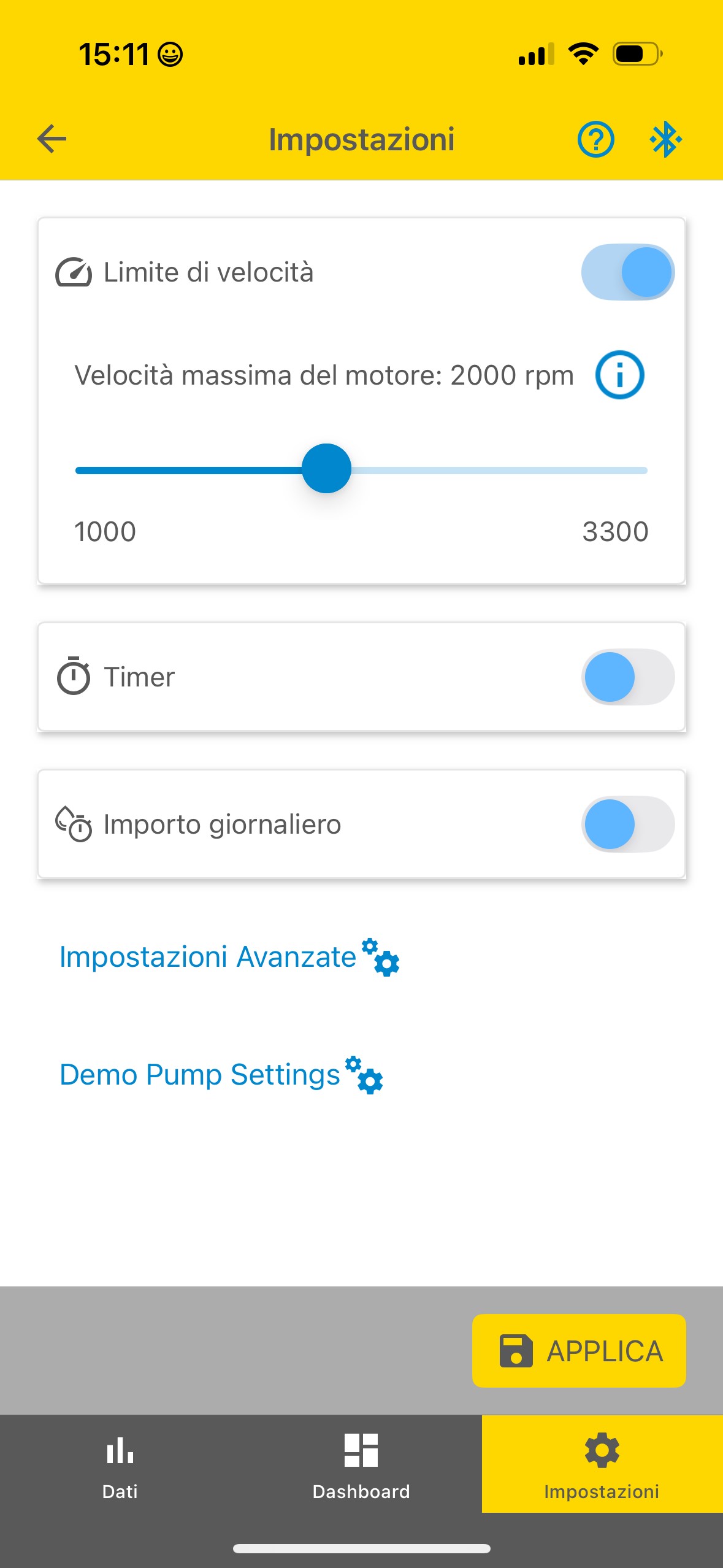
                                            • Make sure the motor speed is not limited in the app settings.<\/li>
                                            • Ensure sufficient solar power is available and check the solar irradiance (cloudy conditions, early morning or late afternoon).<\/li>
                                            • If necessary, increase the power by adding more PV modules (within system limits<\/a>).<\/li>
                                            • Check the voltage<\/a> (Vmp) of your system.<\/li> <\/ul> <\/td>
                                            • Once the required motor speed is reached, the pump will overcome the TDH, water will start flowing, and the app will display a flow rate greater than 0 m³\/h.<\/li> <\/ul> <\/td> <\/tr>
                                            Solid <\/strong><\/td> No light <\/strong><\/td>
                                            • Zero flow shown in the app but water is delivered.<\/li> <\/ul> <\/td>
                                            • Check the TDH value entered in the S-Connect app and correct it.<\/li> <\/ul> <\/td>
                                            • Once the TDH value is corrected, the app will show the correct flow.<\/li> <\/ul> <\/td> <\/tr> <\/tbody> <\/table>

                                              Further reading<\/H2><\/tocentry>
                                              • <\/i>The pump does not start or delivers too little water<\/a><\/li><\/ul><\/div>","sortIndex":0},"fr":{"categories":{"1":"580500"},"title":"Pourquoi ma pompe centrifuge S1-700 affiche-t-elle 0 m\u00b3\/h dans l\u2019application ?","subTitle":"","header":"","html":"

                                                Le système LORENTZ S1-700 utilise des pompes centrifuges. Contrairement aux pompes à déplacement positif, les pompes centrifuges nécessitent une vitesse de rotation minimale du moteur pour surmonter la hauteur manométrique totale (TDH) et commencer à refouler l'eau.<\/p>

                                                Si la puissance disponible n'est pas suffisante pour atteindre cette vitesse minimale, le débit affiché dans l'application sera de « 0 m³\/h<\/strong> » et aucune eau ne sortira de la pompe.<\/p>

                                                Il s'agit d'un comportement normal pour les pompes centrifuges et cela ne génère pas de défaut ni de message d'erreur dans l'application S-Connect.<\/p>

                                                Que peut-on observer dans cette situation ?<\/H3><\/tocentry>
                                                • La pompe fonctionne à une vitesse moteur supérieure à 1000 min-1<\/sup>.<\/li>
                                                • Le débit affiché dans l'application est de 0 m³\/h.<\/li>
                                                • Il est probable qu'aucune eau ne soit distribuée.<\/li>
                                                • Aucun message d'erreur ou de défaut n'est affiché.<\/li> <\/ul>
                                                  fullscreen<\/i><\/div><\/div><\/div>
                                                  fullscreen<\/i><\/div><\/div><\/div>

                                                  Dépannage<\/H2><\/tocentry> <\/colgroup>
                                                  Qu'affiche l'application ?<\/strong><\/td> Comportement des LED dans le contrôleur<\/strong><\/td> Ce qui se passe?<\/strong><\/td> Comment puis-je résoudre ce problème ?<\/strong><\/td> Que va-t-il se passer ensuite ?<\/strong><\/td> <\/tr>
                                                  LED verte<\/strong><\/td> LED rouge<\/strong><\/td> <\/tr> <\/thead>

                                                  Le débit indique
                                                  0 m³\/h bien que la vitesse du moteur soit supérieure à 0<\/strong><\/p>

                                                  <\/strong><\/p> <\/td>

                                                  Solide<\/strong><\/td> Pas de lumière<\/strong><\/td>
                                                  • La pompe tourne, l'application indique un débit nul, mais aucune eau n'est distribuée.<\/li> <\/ul> <\/td>
                                                  • Vérifiez que la vitesse du moteur n'est pas limitée dans les paramètres de l'application.<\/li>
                                                  • Assurez-vous que l'énergie solaire disponible est suffisante et vérifiez l'irradiance solaire (conditions nuageuses, tôt le matin ou en fin d'après-midi).<\/li>
                                                  • Si nécessaire, augmentez la puissance en ajoutant des modules PV supplémentaires (dans les limites du système<\/a> ).<\/li>
                                                  • Vérifiez la tension<\/a> (Vmp) de votre système.<\/li> <\/ul> <\/td>
                                                  • Une fois la vitesse du moteur requise atteinte, la pompe surmontera la TDH, l'eau commencera à couler et l'application affichera un débit supérieur à 0 m³\/h.<\/li> <\/ul> <\/td> <\/tr>
                                                  Solide<\/strong><\/td> Pas de lumière<\/strong><\/td>
                                                  • Débit nul indiqué dans l'application, mais l'eau est bien distribuée.<\/li> <\/ul> <\/td>
                                                  • Vérifiez la valeur TDH saisie dans l'application S-Connect et corrigez-la.<\/li> <\/ul> <\/td>
                                                  • Une fois la valeur TDH corrigée, l'application affichera le débit correct.<\/li> <\/ul> <\/td> <\/tr> <\/tbody> <\/table>

                                                    Pour en savoir plus<\/H2><\/tocentry>
                                                    • <\/i>La pompe ne d\u00e9marre pas ou fournit trop peu d\u2019eau<\/a><\/li><\/ul><\/div>","sortIndex":0},"es":{"categories":{"1":"580500"},"title":"\u00bfPor qu\u00e9 mi bomba centr\u00edfuga S1-700 muestra 0 m\u00b3\/h en la app?","subTitle":"","header":"","html":"

                                                      El sistema LORENTZ S1-700 utiliza bombas centrífugas. A diferencia de las bombas de desplazamiento positivo, las bombas centrífugas requieren una velocidad mínima del motor para superar la altura dinámica total (TDH) y comenzar a bombear agua.<\/p>

                                                      Si la potencia disponible no es suficiente para alcanzar esta velocidad mínima, el caudal mostrado en la app sería “ 0 m³\/h<\/strong> ” y no saldría agua de la bomba.<\/p>

                                                      Este es un comportamiento normal de las bombas centrífugas y no genera un mensaje de error o falla en la aplicación S-Connect.<\/p>

                                                      ¿Qué se puede observar en esta situación?<\/H3><\/tocentry>
                                                      • La bomba está funcionando con una velocidad del motor superior a 1000 rpm.<\/li>
                                                      • El caudal mostrado en la aplicación es 0 m³\/h.<\/li>
                                                      • Probablemente no se entrega agua.<\/li>
                                                      • No se muestra ningún mensaje de falla o error.<\/li> <\/ul>
                                                        fullscreen<\/i><\/div><\/div><\/div>
                                                        fullscreen<\/i><\/div><\/div><\/div>

                                                        Solución de problemas<\/H2><\/tocentry> <\/colgroup>
                                                        ¿Qué muestra la aplicación?<\/strong><\/td> Comportamiento de los LED en el controlador<\/strong><\/td> ¿Lo que está sucediendo?<\/strong><\/td> ¿Cómo puedo solucionar el problema del evento?<\/strong><\/td> ¿Qué pasa después?<\/strong><\/td> <\/tr>
                                                        LED verde<\/strong><\/td> LED rojo<\/strong><\/td> <\/tr> <\/thead>

                                                        El caudal muestra
                                                        0 m³\/h aunque la velocidad del motor sea superior a 0<\/strong><\/p>

                                                        <\/strong><\/p> <\/td>

                                                        Sólido<\/strong><\/td> Sin luz<\/strong><\/td>
                                                        • La bomba gira, la aplicación muestra flujo cero, pero no sale agua.<\/li> <\/ul> <\/td>
                                                        • Asegúrese de que la velocidad del motor no esté limitada en la configuración de la aplicación.<\/li>
                                                        • Asegúrese de que haya suficiente energía solar disponible y verifique la irradiación solar (condiciones nubladas, temprano en la mañana o al final de la tarde).<\/li>
                                                        • Si es necesario, aumente la potencia agregando más módulos fotovoltaicos (dentro de los límites del sistema<\/a> ).<\/li>
                                                        • Verifique el voltaje<\/a> (Vmp) de su sistema.<\/li> <\/ul> <\/td>
                                                        • Una vez que se alcanza la velocidad del motor requerida, la bomba superará la altura dinámica total TDH, el agua comenzará a fluir y la aplicación mostrará un caudal superior a 0 m³\/h.<\/li> <\/ul> <\/td> <\/tr>
                                                        Sólido<\/strong><\/td> Sin luz<\/strong><\/td>
                                                        • En la aplicación se muestra flujo cero, pero se entrega agua.<\/li> <\/ul> <\/td>
                                                        • Verifique el valor TDH ingresado en la aplicación S-Connect y corríjalo.<\/li> <\/ul> <\/td>
                                                        • Una vez corregido el valor de TDH, la aplicación mostrará el flujo correcto.<\/li> <\/ul> <\/td> <\/tr> <\/tbody> <\/table>

                                                          Lecturas adicionales<\/H2><\/tocentry>
                                                          • <\/i>La bomba no arranca o suministra muy poca agua<\/a><\/li><\/ul><\/div>","sortIndex":0},"it":{"categories":{"1":"580500"},"title":"Perché la mia pompa centrifuga S1-700 mostra 0 m³\/h nell’app?","subTitle":null,"header":"","html":"

                                                            Il sistema LORENTZ S1-700 utilizza pompe centrifughe. A differenza delle pompe a spostamento positivo, le pompe centrifughe richiedono una velocità minima del motore per superare la prevalenza dinamica totale (TDH) e iniziare a erogare acqua.<\/p>

                                                            Se la potenza disponibile non è sufficiente per raggiungere questa velocità minima, la portata visualizzata nell'app sarà \" 0 m³\/h<\/strong> \" e dalla pompa non uscirà acqua.<\/p>

                                                            Si tratta di un comportamento normale per le pompe centrifughe e non genera alcun messaggio di errore o guasto nell'app S-Connect.<\/p>

                                                            Cosa si può osservare in questa situazione?<\/H3><\/tocentry>
                                                            • La pompa funziona con una velocità del motore superiore a 1000 giri\/min.<\/li>
                                                            • La portata indicata nell'app è 0 m³\/h.<\/li>
                                                            • Probabilmente non viene erogata acqua.<\/li>
                                                            • Non viene visualizzato alcun messaggio di errore o guasto.<\/li> <\/ul>
                                                              fullscreen<\/i><\/div><\/div><\/div>
                                                              fullscreen<\/i><\/div><\/div><\/div>

                                                              Risoluzione dei problemi<\/H2><\/tocentry> <\/colgroup>
                                                              Cosa mostra l'app?<\/strong><\/td> Comportamento dei LED nel controller<\/strong><\/td> Che cosa sta accadendo?<\/strong><\/td> Come posso risolvere i problemi dell'evento?<\/strong><\/td> Cosa succederà adesso?<\/strong><\/td> <\/tr>
                                                              LED verde<\/strong><\/td> LED rosso<\/strong><\/td> <\/tr> <\/thead>

                                                              La portata mostra
                                                              0 m³\/h anche se la velocità del motore è superiore a 0<\/strong><\/p>

                                                              <\/strong><\/p> <\/td>

                                                              Solido<\/strong><\/td> Nessuna luce<\/strong><\/td>
                                                              • La pompa gira, l'app mostra un flusso pari a zero, ma non viene erogata acqua.<\/li> <\/ul> <\/td>
                                                              • Assicurati che la velocità del motore non sia limitata nelle impostazioni dell'app.<\/li>
                                                              • Assicurarsi che sia disponibile sufficiente energia solare e controllare l'irradiazione solare (condizioni nuvolose, mattina presto o tardo pomeriggio).<\/li>
                                                              • Se necessario, aumentare la potenza aggiungendo altri moduli fotovoltaici (entro i limiti del sistema<\/a> ).<\/li>
                                                              • Controllare la tensione<\/a> (Vmp) del sistema.<\/li> <\/ul> <\/td>
                                                              • Una volta raggiunta la velocità del motore richiesta, la pompa supererà il TDH, l'acqua inizierà a scorrere e l'app visualizzerà una portata maggiore di 0 m³\/h.<\/li> <\/ul> <\/td> <\/tr>
                                                              Solido<\/strong><\/td> Nessuna luce<\/strong><\/td>
                                                              • L'app mostra un flusso nullo, ma l'acqua viene erogata.<\/li> <\/ul> <\/td>
                                                              • Controllare il valore TDH inserito nell'app S-Connect e correggerlo.<\/li> <\/ul> <\/td>
                                                              • Una volta corretto il valore TDH, l'app mostrerà il flusso corretto.<\/li> <\/ul> <\/td> <\/tr> <\/tbody> <\/table>

                                                                Ulteriori letture<\/H2><\/tocentry>
                                                                • <\/i>La pompa non si avvia o eroga poca acqua<\/a><\/li><\/ul><\/div>","sortIndex":0},"pt":{"categories":{"1":"580500"},"title":"Porque \u00e9 que a minha bomba centr\u00edfuga S1-700 mostra 0 m\u00b3\/h na aplica\u00e7\u00e3o?","subTitle":"","header":"","html":"

                                                                  O sistema LORENTZ S1-700 utiliza bombas centrífugas. Ao contrário das bombas de deslocamento positivo, as bombas centrífugas requerem uma velocidade mínima do motor para vencer a altura dinâmica total (TDH) e começar a bombear água.<\/p>

                                                                  Se a potência disponível não for suficiente para atingir essa velocidade mínima, a vazão exibida no aplicativo será \" 0 m³\/h<\/strong> \" e nenhuma água sairá da bomba.<\/p>

                                                                  Esse é um comportamento normal para bombas centrífugas e não gera nenhuma mensagem de falha ou erro no aplicativo S-Connect.<\/p>

                                                                  O que se pode observar nesta situação?<\/H3><\/tocentry>
                                                                  • A bomba está funcionando com uma velocidade do motor superior a 1000 rpm.<\/li>
                                                                  • A vazão exibida no aplicativo é de 0 m³\/h.<\/li>
                                                                  • Provavelmente não há entrega de água.<\/li>
                                                                  • Nenhuma mensagem de falha ou erro é exibida.<\/li> <\/ul>
                                                                    fullscreen<\/i><\/div><\/div><\/div>
                                                                    fullscreen<\/i><\/div><\/div><\/div>

                                                                    Solução de problemas<\/H2><\/tocentry> <\/colgroup>
                                                                    O que o aplicativo mostra?<\/strong><\/td> Comportamento dos LEDs no controlador<\/strong><\/td> O que está acontecendo?<\/strong><\/td> Como posso solucionar problemas relacionados ao evento?<\/strong><\/td> O que acontece a seguir?<\/strong><\/td> <\/tr>
                                                                    LED Verde<\/strong><\/td> LED vermelho<\/strong><\/td> <\/tr> <\/thead>

                                                                    A taxa de fluxo mostra
                                                                    0 m³\/h embora a velocidade do motor seja superior a 0<\/strong><\/p>

                                                                    <\/strong><\/p> <\/td>

                                                                    Sólido<\/strong><\/td> Sem luz<\/strong><\/td>
                                                                    • A bomba gira, o aplicativo mostra fluxo zero, mas não sai água.<\/li> <\/ul> <\/td>
                                                                    • Verifique se a velocidade do motor não está limitada nas configurações do aplicativo.<\/li>
                                                                    • Certifique-se de que haja energia solar suficiente disponível e verifique a irradiação solar (condições de céu nublado, início da manhã ou final da tarde).<\/li>
                                                                    • Se necessário, aumente a potência adicionando mais módulos fotovoltaicos (dentro dos limites do sistema<\/a> ).<\/li>
                                                                    • Verifique a tensão<\/a> (Vmp) do seu sistema.<\/li> <\/ul> <\/td>
                                                                    • Assim que a velocidade do motor necessária for atingida, a bomba vencerá a altura manométrica total (TDH), a água começará a fluir e o aplicativo exibirá uma vazão superior a 0 m³\/h.<\/li> <\/ul> <\/td> <\/tr>
                                                                    Sólido<\/strong><\/td> Sem luz<\/strong><\/td>
                                                                    • O aplicativo mostra fluxo zero, mas a água está sendo fornecida.<\/li> <\/ul> <\/td>
                                                                    • Verifique o valor de TDH inserido no aplicativo S-Connect e corrija-o.<\/li> <\/ul> <\/td>
                                                                    • Assim que o valor de TDH for corrigido, o aplicativo mostrará a vazão correta.<\/li> <\/ul> <\/td> <\/tr> <\/tbody> <\/table>

                                                                      Leitura complementar<\/H2><\/tocentry>
                                                                      • <\/i>A bomba n\u00e3o inicia ou fornece pouca \u00e1gua<\/a><\/li><\/ul><\/div>","sortIndex":0},"de":{"categories":{"1":"580500"},"title":"Warum zeigt meine S1-700 Kreiselpumpe in der App 0 m³\/h an?","subTitle":null,"header":"","html":"

                                                                        Das LORENTZ S1-700-System verwendet Kreiselpumpen. Im Gegensatz zu Verdrängerpumpen benötigen Kreiselpumpen eine Mindestdrehzahl des Motors, um die gesamte Förderhöhe (TDH) zu überwinden und mit der Wasserförderung zu beginnen.<\/p>

                                                                        Reicht die verfügbare Leistung nicht aus, um diese Mindestdrehzahl zu erreichen, wird in der App eine Durchflussrate von \" 0 m³\/h<\/strong> \" angezeigt, und es kommt kein Wasser aus der Pumpe.<\/p>

                                                                        Dies ist ein normales Verhalten für Kreiselpumpen und führt nicht zu einer Fehlermeldung in der S-Connect-App.<\/p>

                                                                        Was lässt sich in dieser Situation beobachten?<\/H3><\/tocentry>
                                                                        • Die Pumpe läuft mit einer Motordrehzahl von über 1000 1\/min.<\/li>
                                                                        • Die in der App angezeigte Durchflussrate beträgt 0 m³\/h.<\/li>
                                                                        • Vermutlich wird kein Wasser geliefert.<\/li>
                                                                        • Es wird keine Fehlermeldung angezeigt.<\/li> <\/ul>
                                                                          fullscreen<\/i><\/div><\/div><\/div>
                                                                          fullscreen<\/i><\/div><\/div><\/div>

                                                                          Fehlerbehebung<\/H2><\/tocentry> <\/colgroup>
                                                                          Was zeigt die App an?<\/strong><\/td> Verhalten der LEDs im Controller<\/strong><\/td> Was passiert?<\/strong><\/td> Wie kann ich das Problem beheben?<\/strong><\/td> Was geschieht als Nächstes?<\/strong><\/td> <\/tr>
                                                                          LED Grün<\/strong><\/td> LED Rot<\/strong><\/td> <\/tr> <\/thead>

                                                                          Die Durchflussrate zeigt an
                                                                          0 m³\/h, obwohl die Motordrehzahl über 0 liegt<\/strong><\/p>

                                                                          <\/strong><\/p> <\/td>

                                                                          Solide<\/strong><\/td> Kein Licht<\/strong><\/td>
                                                                          • Die Pumpe dreht sich, die App zeigt einen Durchfluss von null an, aber es wird kein Wasser gefördert.<\/li> <\/ul> <\/td>
                                                                          • Stellen Sie sicher, dass die Motordrehzahl in den App-Einstellungen nicht begrenzt ist.<\/li>
                                                                          • Stellen Sie sicher, dass ausreichend Solarenergie zur Verfügung steht und prüfen Sie die Sonneneinstrahlung (bewölkt, am frühen Morgen oder späten Nachmittag).<\/li>
                                                                          • Bei Bedarf kann die Leistung durch Hinzufügen weiterer PV-Module erhöht werden (innerhalb der Systemgrenzen<\/a> ).<\/li>
                                                                          • Überprüfen Sie die Systemspannung<\/a> (Vmp).<\/li> <\/ul> <\/td>
                                                                          • Sobald die erforderliche Motordrehzahl erreicht ist, überwindet die Pumpe die TDH, das Wasser beginnt zu fließen, und die App zeigt eine Durchflussrate von mehr als 0 m³\/h an.<\/li> <\/ul> <\/td> <\/tr>
                                                                          Solide<\/strong><\/td> Kein Licht<\/strong><\/td>
                                                                          • In der App wird ein Durchfluss von Null angezeigt, aber es wird Wasser geliefert.<\/li> <\/ul> <\/td>
                                                                          • Prüfen Sie den in der S-Connect-App eingegebenen TDH-Wert und korrigieren Sie ihn.<\/li> <\/ul> <\/td>
                                                                          • Sobald der TDH-Wert korrigiert ist, zeigt die App den korrekten Durchfluss an.<\/li> <\/ul> <\/td> <\/tr> <\/tbody> <\/table>

                                                                            Weiterführende Literatur<\/H2><\/tocentry>
                                                                            • <\/i>Die Pumpe l\u00e4uft nicht an oder f\u00f6rdert zu wenig Wasser<\/a><\/li><\/ul><\/div>","sortIndex":0}},"2266":{"en":{"categories":{"1":"580200"},"title":"Adjusting the water level using the Tank Full Switch counterweight","subTitle":"","header":"","html":"

                                                                              The Tank Full Switch uses a float and a counterweight to define the pump ON and OFF levels inside the tank. Correct adjustment is essential to ensure reliable switching and to avoid frequent start\/stop cycles.<\/p>

                                                                              Before proceeding, make sure that the “Tank Full Switch” accessory is activated (either manually or via the S-connect app). See article

                                                                              • <\/i>Function and use of Tank Full Switch<\/a><\/li><\/ul><\/div> <\/blockquote>

                                                                                Role of the counterweight:<\/H2><\/tocentry>

                                                                                The counterweight is a critical component of the Tank Full Switch. It:<\/p>

                                                                                • Fixes the switching point<\/li>
                                                                                • Ensures a defined tipping movement of the float<\/li>
                                                                                • Prevents switch fluttering (frequent ON\/OFF cycles)<\/li>
                                                                                • Prevents the float from moving uncontrollably<\/li> <\/ul>

                                                                                  Without the counterweight, the float would not tilt correctly and the switch would not operate reliably.<\/p> <\/blockquote>

                                                                                  Step-by-Step adjustment<\/H2><\/tocentry>

                                                                                  WARNING - Disconnect power from the controller before performing any installation, inspection, maintenance or cleaning activities.<\/p>

                                                                                  Place the float and counterweight inside the tank.<\/p>

                                                                                  Position the float at approximately the desired maximum water level (Pump OFF position).<\/p>

                                                                                  Secure the float cable at the top of the tank using a cable clamp or another suitable fixing point.<\/p> <\/div>

                                                                                  The counterweight determines the pivot point of the float and therefore:<\/p>

                                                                                  • The water level at which the pump switches OFF<\/li>
                                                                                  • The water level at which the pump switches ON<\/li>
                                                                                  • The distance between both points (the pumping range or hysteresis)<\/li> <\/ul>
                                                                                    • The further the counterweight is from the float, the greater the pumping range.<\/li>
                                                                                    • The closer the counterweight is to the float, the smaller the pumping range.<\/li> <\/ul> <\/blockquote>

                                                                                      Adjust the position of the counterweight by sliding it along the cable until the desired level range is achieved.<\/p>

                                                                                      If necessary, also readjust the fixing point of the float cable at the top of the tank.<\/p>

                                                                                      fullscreen<\/i><\/div><\/div><\/div> <\/div>

                                                                                      Verify float clearance inside the tank, ensuring that the float:<\/p>

                                                                                      • Hangs freely<\/li>
                                                                                      • Does not touch the walls of the tank<\/li>
                                                                                      • Does not come into contact with pipes or other internal elements<\/li>
                                                                                      • Does not rest on the bottom of the tank<\/li> <\/ul>

                                                                                        Minimum recommended distance from tank walls: ≥ 5 cm [2 in]<\/p> <\/blockquote> <\/div>

                                                                                        Reconnect power and turn on the controller. Check that:<\/p>

                                                                                        • The pump switches OFF when the upper level is reached<\/li>
                                                                                        • The pump switches ON again when the water level drops<\/li> <\/ul>

                                                                                          If required, readjust the position of the counterweight until the desired switching behavior is achieved.<\/p> <\/div>

                                                                                          Further reading<\/H2><\/tocentry>
                                                                                          • <\/i>Function and use of Tank Full Switch<\/a><\/li><\/ul><\/div>","sortIndex":0},"fr":{"categories":{"1":"580200"},"title":"R\u00e9glage du niveau d\u2019eau \u00e0 l\u2019aide du contrepoids de l\u2019Interrupteur de r\u00e9servoir plein","subTitle":"","header":"","html":"

                                                                                            Le réglage du contrepoids permet de définir le niveau d’eau précis auquel \"l’Interrupteur de réservoir plein<\/strong>\" change d’état. La procédure de réglage typique est la suivante :<\/p>

                                                                                            Positionnez le flotteur approximativement au niveau d’eau maximal souhaité à l’intérieur du réservoir.<\/p> <\/div>

                                                                                            Faites glisser le contrepoids le long du câble, en le rapprochant ou en l’éloignant du flotteur jusqu’à la position souhaitée. La position du contrepoids détermine la force que le flotteur doit exercer pour activer le mécanisme interne.<\/p> <\/div>

                                                                                            Remplissez lentement le réservoir et observez le point auquel l’interrupteur change d’état.<\/p> <\/div>

                                                                                            Ajustez le contrepoids le long du câble, en le rapprochant ou en l’éloignant du flotteur, jusqu’à ce que le niveau d’activation (lorsque l’interrupteur interne s’active) corresponde au niveau d’eau souhaité.<\/p> <\/div>

                                                                                            Une fois le niveau correct atteint, assurez-vous que le contrepoids est solidement fixé afin d’éviter tout déplacement dû au mouvement ou aux vibrations.<\/p> <\/div>

                                                                                            Conseils pratiques<\/H3><\/tocentry>
                                                                                            • De petits ajustements peuvent entraîner des variations importantes du niveau d’activation ; il est donc recommandé de déplacer le contrepoids par petites étapes.<\/li>
                                                                                            • Si l’interrupteur s’active trop tôt (avant d’atteindre le niveau d’eau souhaité), rapprochez le contrepoids du flotteur.<\/li>
                                                                                            • Si l’interrupteur s’active trop tard (après avoir dépassé le niveau d’eau souhaité), éloignez le contrepoids du flotteur.<\/li> <\/ul> <\/div>